MC2 Karafiol Scholars Profile: Evelyn Brusznicki
February 17, 2026
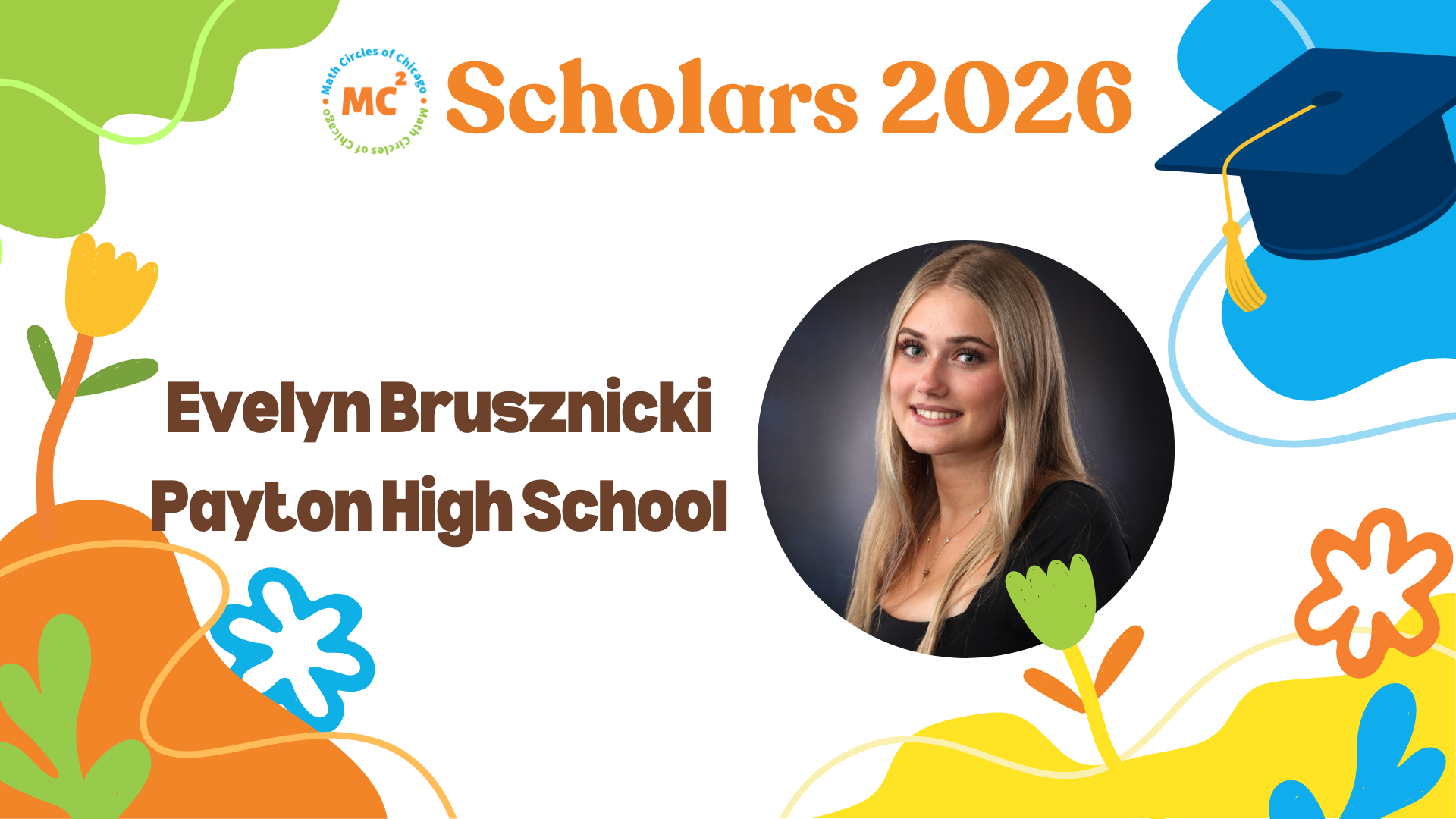
Evelyn Brusznicki
Ogden-Jenner ES
Payton HS
How did you develop an interest in mathematics? What has your learning experience been like in school up to this point? What challenges, socially and/or academically, have you faced in this journey?
My interest in mathematics began in sixth grade. When we learned about ratios and percents, I was fascinated by how these rules could explain real-life patterns. I began to connect what I learned in class to patterns and stereotypes I noticed around me, realizing how math could uncover truths about the world. That year was the first time I felt genuinely excited to solve problems. Covid sadly interupted this passion, as my year was cut in half. Without classroom discussions or collaboration, the subject started to feel distant. But this longing to return to math class helped me realize how much I loved the subject. I truly believe my deeper love for math began when I joined Math Circles in elementary school. I loved the process of exploring different methods, seeing patterns, and finding solutions. Math has always come naturally to me. I’ve never had to study for tests, yet I consistently earned A’s. While that may sound strange, I think it speaks to the way math clicks for me. It’s one of the few subjects where answers aren’t subjective. But outside of that passion, not everyone saw me that way. I was the student who always got 100s on math tests, but instead of admiration, it often led to questioning. Some classmates thought it was just luck or coincidence. Being dismissed by others made me question myself at times. Still, I didn’t let their opinions stop me! Now, math represents more than just a school subject to me. I use this constantly in the real world to find patterns, and I look forward to every math class I have.
What is your mathematical power? How has your work with Math Circles of Chicago helped you develop that power?
My mathematical power is the ability to see connections between numbers, ideas, and people. Math Circles of Chicago helped me realize that math isn’t just about solving problems, it’s about exploring patterns and thinking creatively. Before joining Math Circles, I viewed math as a personal skill. At Math Circles, I discovered the joy of open-ended problems. Instead of working toward one correct answer, we explored multiple ways of thinking. I became more confident not only in my answers, but in my reasoning. It also helped me find my voice, I learned to explain my thought process, ask questions, and listen to how others approached the same problem differently. Those conversations strengthened both my understanding and my confidence in collaborative learning. One of the most meaningful parts of Math Circles was realizing that belonging in math isn’t about being the fastest or the best. It’s about curiosity and persistence. For a long time, I struggled with feeling like I didn’t fit the typical image of a “math person.” Even when I was earning 100s on tests, some classmates assumed it was a coincidence. That experience made me determined to make math spaces feel more welcoming for everyone, especially for students who might be doubted the way I once was. Last year, a girl in our Cheng class was sad and stressed. I helped explain the problem using terms she may know from TV. She was able to figure out the answer. In Math Circles, I found belonging through shared excitement. Everyone, no matter their skill level, was encouraged to think deeply and take risks.
MC2 College Pathways is dedicated to helping students find their own pathway forward in STEM. Please describe your future plans for college and beyond.
In college, I plan to major in statistics or data science. I’ve always been fascinated by how numbers can reveal patterns in human behavior, social systems, and even inequality. Math Circles of Chicago has helped me see math as more than just solving equations. It taught me how to think critically and creatively about problems, even when they don’t have clear answers. I learned to slow down, try different approaches, and not be afraid of being wrong. That mindset has made me more confident, and I know it will help me in college when I’m working with complicated data or in a math class. One of the biggest things I’ve learned from Math Circles is that math is a way of thinking, not just a subject in school. When I look at a dataset or a math problem now, I don’t just look for the right answer. I want to keep using math in that way: to find meaning in data and use it to make smarter, fairer decisions. I’m especially interested in using statistics to study social issues like education or inequality. I think data can make a real difference when it’s used responsibly, and I want to be part of that kind of work. At the same time, I want to help others see that math isn’t something to be scared of.