MC2 Karafiol Scholars Profile: Kamaya Carpenter
December 30, 2025
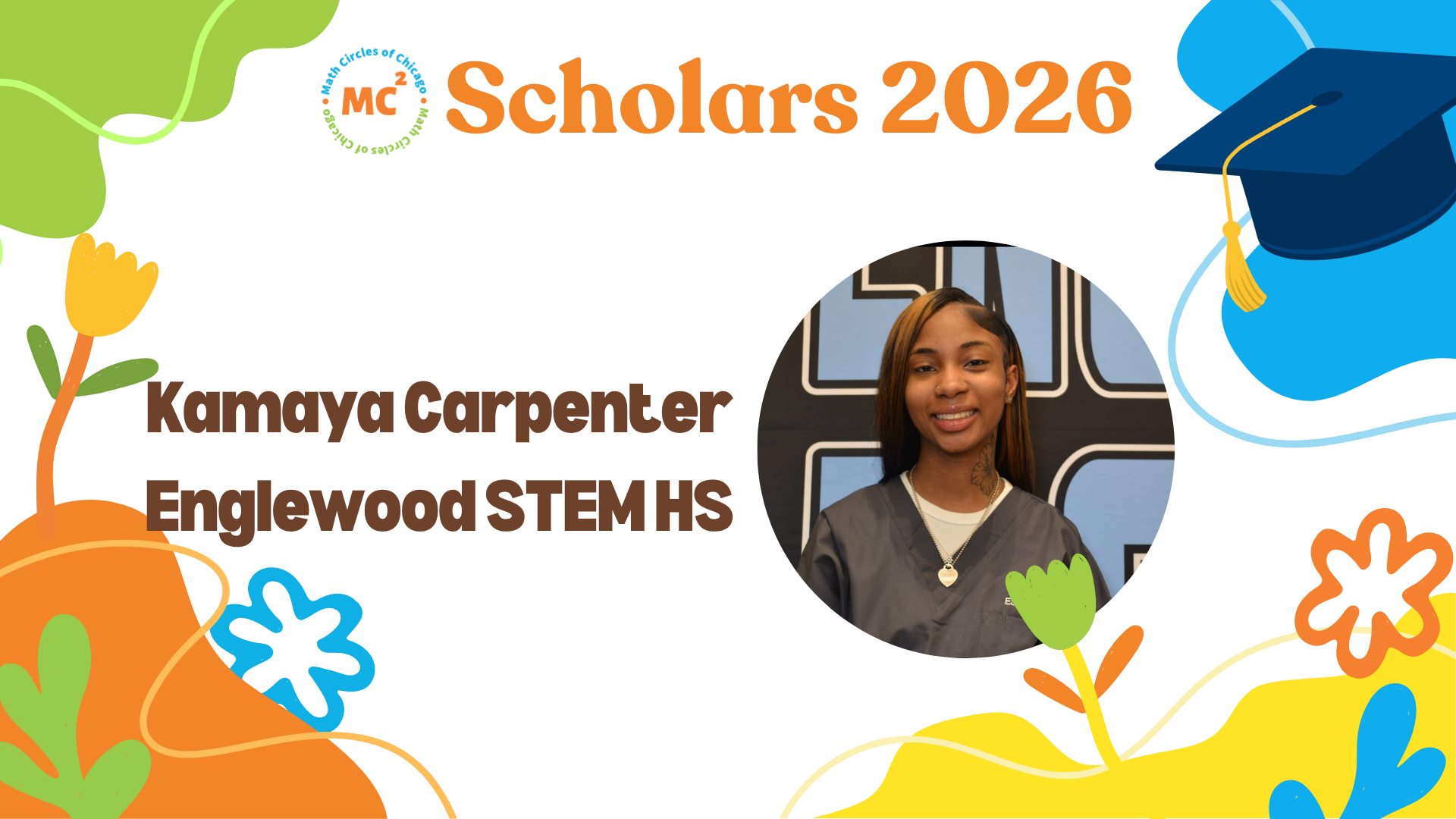
Kamaya Carpenter
Mireles ES
Englewood STEM HS
Math Circles of Chicago has prepared me for that future by teaching me how to think critically and collaboratively
Kamaya came to Math Circles of Chicago via our summer programs. She has taken some of the ideas from those camps and continues to enjoy solving logic puzzles, working on online coding challenges, and reading about how math connects to real-world issues like technology and the environment.
How did you develop an interest in mathematics? What has your learning experience been like in school up to this point? What challenges, socially and/or academically, have you faced in this journey?
My interest in mathematics began with curiosity — I’ve always wanted to know why things work, not just how. When I was younger, I liked finding patterns in numbers and solving puzzles just for fun. Over time, I realized that math isn’t just about getting the right answer; it’s about reasoning, creativity, and perseverance.
In school, I’ve had both successes and challenges in math. Some topics came naturally, while others took longer to understand. At times, I felt hesitant to ask questions because I worried others might think I didn’t “get it.” Over time, though, I learned that asking questions is a sign of curiosity, not weakness. That mindset helped me grow stronger academically and more confident socially. Joining Math Circles of Chicago gave me a community where curiosity was celebrated — where struggling with a problem meant you were truly learning.
What is your mathematical power? How has your work with Math Circles of Chicago helped you develop that power?
I see my “mathematical power” as problem solving through persistence and creativity. Math Circles of Chicago helped me develop that power by encouraging me to explore multiple paths to a solution and to appreciate the beauty of thinking deeply rather than rushing to finish quickly. The collaborative discussions have taught me how to explain my reasoning, listen to others’ ideas, and refine my understanding — skills that go far beyond the classroom.
I’ve also learned the importance of belonging in math spaces. In Math Circles, I’ve felt welcome because everyone’s ideas are valued, no matter their skill level or background. I’ve tried to share that sense of belonging with others by encouraging peers who feel unsure about math and reminding them that struggling with a problem is part of the process. I think one of the biggest obstacles to belonging is the belief that math ability is fixed — that some people are “math people” and others aren’t. Spaces like Math Circles help break that myth by showing that everyone can grow mathematically.
MC2 College Pathways is dedicated to helping students find their own pathway forward in STEM. Please describe your future plans for college and beyond.
In the future, I plan to pursue a college pathway that keeps math at its core — possibly in computer science, data science, or engineering. I’m drawn to the way math connects abstract ideas to real-world solutions, from building efficient algorithms to analyzing environmental data.
Math Circles of Chicago has prepared me for that future by teaching me how to think critically and collaboratively. More importantly, it has shown me that math is not just a subject, but a language for exploring ideas and solving problems that matter. Whether or not my career stays directly in mathematics, I know the way of thinking I’ve learned here will guide me throughout my life.